The Aging Well Blueprint 8-Week Program
8 Weeks to Build Healthier Habits for the Years Ahead
Practical education, guided activities, and daily tools for improving nutrition, hydration, movement, strength, sleep, stress management, and other habits that support healthy aging.
Designed for medical practices, community organizations, health plans, senior-serving organizations, families, and sponsors who want to help older adults remain healthier, more capable, and more independent.

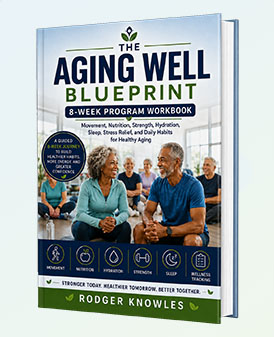 Participant workbook
Everyone Has a Stake in Healthier Aging
Healthy aging benefits more than one participant.
When an older adult becomes stronger, more mobile, better informed, and more confident in managing daily health habits, the benefit can extend to families, healthcare providers, insurers, community organizations, employers, and the broader community.
The program is designed to support behaviors associated with healthier aging. Organizations may value programs like this because prevention, self-management, physical activity, nutrition education, and stronger clinical-community connections can support broader population-health goals.
01Extend Healthy Aging Beyond the Exam Room
Medical practices can complement time-limited visits with structured education about nutrition, movement, hydration, sleep, stress, and healthy routines.
- Reinforce preventive-health messages
- Support patient engagement and follow-through
- Connect lifestyle conversations between visits
02A Community Health Program With Prevention at Its Center
Hospitals and health systems may evaluate the program for alignment with their own Community Health Needs Assessment and implementation priorities.
Alignment depends on local needs, organizational review, and applicable community-benefit requirements.
03Turn the Senior Center Into a Healthy-Aging Classroom
Senior centers, libraries, recreation programs, Area Agencies on Aging, and ADRCs can offer an eight-week cohort with education, social connection, accountability, and practical activities.
04Healthier Members Can Be Good for Everyone
Health plans have a financial and clinical interest in helping members manage chronic conditions, remain physically active, and avoid preventable complications. Plans may evaluate sponsorship within approved wellness, supplemental-benefit, community, or population-health strategies.
Discuss a Health Plan Partnership
05Give Mom or Dad More Than Advice. Give Them a Plan.
Families may sponsor a parent, organize a group through a church or community, or ask a medical practice or senior community to host the program.
Tell Me About Family Enrollment
06A Wellness Program Residents Can Join Together
Independent living, retirement, active-adult, and appropriate assisted-living communities can add group education, family engagement, and wellness programming without substituting for licensed therapy or clinical care.
07For Caregiver, Home-Care, and Home-Health Organizations
Use educational materials and community workshops to reinforce healthy habits, support family conversations, and give older adults a constructive role in their own health-management efforts.
08Healthy Aging Does Not Begin at Retirement
Employers, unions, retiree associations, and corporate wellness teams can support older workers, retirees, and employees caring for aging parents.
09Bring Healthy Aging Education Into the Community
Churches, faith communities, municipalities, parks departments, nonprofits, and age-friendly initiatives can host or sponsor accessible local cohorts.
Bring the Program to Your City or Community
10Sponsor Healthier Aging in Your Community
Foundations, local businesses, healthcare companies, pharmacies, grocers, and charitable donors can underwrite workbooks, participants, one location, or multiple cohorts while respecting the independence of program health content.
Week 1Understanding Your Health Starting Point
Week 2Food, Nutrition, and Blood Sugar
Week 3Hydration and Everyday Nutrition Habits
Week 4Movement, Mobility, and Strength
Week 5Heart Health and Healthy Weight
Week 6Sleep, Stress, and Emotional Wellness
Week 7Tracking Health, Medications, and Preventive Care
Week 8Building Your Personal 90-Day Aging Well Plan
Why Group Delivery Matters
Learning together creates structure and connection.
A cohort can begin together, meet once each week for eight weeks, and use the workbook between sessions. Shared meetings create room for questions, encouragement, accountability, and consistent participation.
On-siteInstructor-ledGroup-basedHybridPotentially virtual
20
participants begin together
One weekly session for eight weeks, supported by practical workbook activities between meetings.
For Participants
More Than Eight Classes
- The Aging Well Blueprint 8-Week Program Workbook
- Weekly guided lessons and reflection exercises
- Habit, hydration, movement, and nutrition activities
- Progress reviews, goal setting, and a final 90-day plan
For the Host Organization
A Practical Cohort Framework
- Facilitator and delivery coordination
- Participant enrollment guidance and workbooks
- Attendance and completion tracking
- Participant feedback and a summary participation report
The exact pilot package and available materials are confirmed during program planning.
Measure Participation. Build the Evidence.
Start with appropriate program-level measures.
Organizations may track enrollment, attendance, completion, participant satisfaction, self-reported confidence and habits, goal completion, and program engagement. The public website does not collect participant health information.
Help Us Build the Evidence
We welcome evaluation partnerships.
The long-term goal is a standardized curriculum, appropriate baseline and completion surveys, independent evaluation, community-site replication, and formal evidence review. The program is not currently represented as an evidence-based intervention.
Older Americans Act Health-Promotion Funding
Title III-D supports evidence-based disease-prevention and health-promotion programs for adults age 60 and older. The Aging Well Blueprint does not currently claim Title III-D approval or eligibility. We welcome aging-service and evaluation partners interested in pursuing qualification where appropriate.
Area Agencies on Aging & ADRCs
State Units on Aging, Area Agencies on Aging, ADRCs, and local providers may explore partnership opportunities subject to local priorities, procurement, eligibility, and program requirements.
Federal Healthy-Aging Grants
Federal, state, and local opportunities change regularly. We welcome partnerships with eligible organizations pursuing healthy-aging, chronic-disease self-management, and preventive-health funding.
Hospital Community Benefit
Potential alignment may exist when a hospital's Community Health Needs Assessment identifies chronic disease, nutrition, physical activity, preventive health, older adults, health literacy, or health disparities. Alignment is not automatic.
Health Plan Sponsorship
Plans may evaluate sponsored cohorts or inclusion within approved wellness, supplemental-benefit, community, or population-health strategies. Coverage decisions remain with each payer and applicable rules.
Value-Based Care & Population Health
ACOs, primary-care groups, risk-bearing organizations, and clinically integrated networks may value education, prevention, self-management, community support, healthy eating, and physical activity. No specific utilization or cost outcome is promised.
Foundation, Corporate & Community Support
Community and hospital foundations, charitable trusts, faith-based grants, corporate giving, local philanthropy, and businesses may sponsor workbooks, participants, or complete community cohorts.
Family Sponsorship
Families may fund individual or gift enrollment, help a parent attend with friends, or support a group through a senior community, church, or local organization.
Funding is never guaranteed. Eligibility and sponsorship vary by jurisdiction, payer, organization, grant, and program requirements. Traditional Medicare should not be presented as automatically covering this program.
Start With One 8-Week Pilot
A focused way to learn before expanding.
One pilot gives a medical group, insurer, city, senior center, church, or health system a practical starting point.
Discuss a Pilot Program
- 1Select one location.
- 2Enroll one cohort.
- 3Deliver eight weekly sessions.
- 4Track attendance and engagement.
- 5Collect participant feedback.
- 6Review results and decide whether to expand.
Community Cohort
One location. One group.
Multi-Site Program
Several senior or community centers.
Health System Program
Multiple clinics or locations.
Health Plan Program
A sponsored member population.
Community Sponsorship
A foundation or company underwrites participants.
Family Sponsorship
Individual or family-funded participation.
Program scope and pricing are developed for each partnership. No coverage or funding source is assumed.
Bring The Aging Well Blueprint to Your Community
Tell us what you would like to build.
Request information about hosting, sponsorship, a community cohort, a health-plan or medical partnership, or an initial pilot.
What is The Aging Well Blueprint 8-Week Program?
It is an educational wellness program combining weekly group learning, a participant workbook, guided activities, habit-building tools, and a personal 90-day plan.
Who is the program designed for?
It is designed for older adults and for organizations, families, caregivers, communities, and sponsors interested in practical healthy-aging education.
Does someone have to be 65 to participate?
No fixed age requirement is presented on this page. Cohort eligibility can be set with the host organization based on program goals and participant needs.
Is this a medical treatment program?
No. It is an educational wellness program and does not replace individualized diagnosis, treatment, physical therapy, nutrition therapy, or other licensed care.
Can a senior center, medical practice, or church host it?
Yes, these organizations may discuss an on-site, hybrid, or other appropriate cohort format with us.
Can an insurance company sponsor members?
A health plan may evaluate sponsorship or an approved wellness, community, supplemental-benefit, or population-health arrangement. Any offering requires plan-level review and compliance with applicable rules.
Can a family sponsor a parent?
Yes. Families may ask about individual, gift, or group sponsorship pathways as they become available.
Can grant funds be used?
Possibly, subject to the grant, applicant eligibility, jurisdiction, program requirements, and funder approval. The program does not claim automatic eligibility for any grant.
Does Medicare pay for the program?
Traditional Medicare should not be presented as automatically covering The Aging Well Blueprint 8-Week Program. Some health plans, community organizations, grant-funded initiatives, employers, health systems, or sponsors may choose to fund participation. Coverage and sponsorship vary and should be confirmed before enrollment.
Can the program be delivered virtually?
A virtual or hybrid format may be considered where it is appropriate for the host, facilitator, participants, and available materials.
How many people can participate?
Cohort size is established with the host organization. A pilot might begin with one manageable group before expanding.
What materials are included?
Participants receive the 8-Week Program Workbook and guided weekly activities. The exact host package is confirmed during planning.
Do participants need to be physically fit?
No. The educational program is intended to meet adults at varied starting points. Participants should follow their healthcare professionals' guidance before changing exercise or nutrition routines.
Healthier Aging Is a Shared Investment
Bring practical healthy-aging education to the people who matter to you.
Whether you serve older adults, insure them, care for them, employ them, or love them, helping people remain healthier and more capable benefits the entire community.